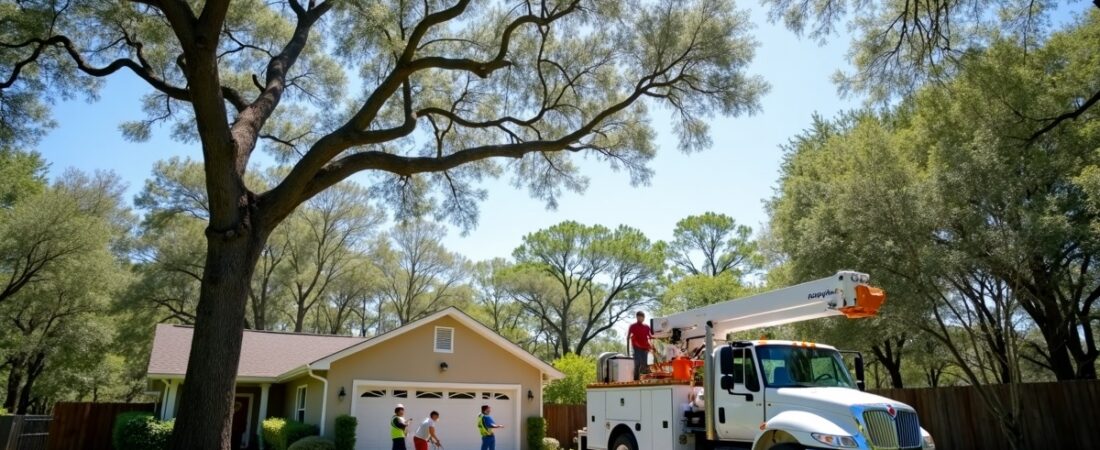
Hurricane-Season Tree Prep for Santa Rosa County Homeowners (Pace, FL)
If you own a home in Pace, Milton, or anywhere in Santa Rosa County, the trees on your lot are both a major asset and — during a serious storm — a major risk. A well-maintained live oak or a properly managed pine stand can ride out a tropical system with little damage. A neglected one can put a limb through the roof, drop a pine across the driveway, or take out a fence.
We’ve been through this recently. Hurricane Sally (2020) crawled ashore as a slow Category 2 and sat over Santa Rosa County for the better part of a day. The Blackwater River hit record flood stage through Milton, and wind and days of soaking rain brought trees and power lines down across Pace and the whole county. The lesson from Sally is the same one every Gulf Coast storm teaches: the trees that came through were mostly the ones maintained before the season. The ones that failed — snapped pines, split oaks, uprooted trees on fences and rooflines — were largely the ones nobody had touched.
This guide walks Santa Rosa County homeowners through what to do to get their trees ready.
When to Start: The Pre-Season Window
The ideal window for pre-hurricane work is February through April — at least 6 to 8 weeks before the June 1 start of the Atlantic hurricane season.
Wound closure. Cuts need time to close before the brutal summer heat and humidity. Trees trimmed in spring can start compartmentalizing before the high-fungal-pressure wet season.
Scheduling availability. Demand for tree service spikes the moment a storm shows up on the models. A system five days out in the Gulf triggers a wave of last-minute calls no crew can absorb. Scheduling in late winter or early spring means you can actually get on the calendar.
Removal time. If the assessment turns up trees that need to come down — dead pines, compromised oaks — you want time to remove and clean up before the season, not scramble two weeks before landfall.
That said, prep in May or early June still beats doing nothing. The goal isn’t perfection; it’s getting the worst hazards handled before you need a chainsaw more than your neighbors do.
Step 1: Walk Your Property
Before you call anyone, do a systematic walk. You’re looking for risk factors and thinking about what’s in the fall zone if a tree fails.
For each significant tree, ask:
- Is any part of it dead? (Large dead branches are the #1 source of storm debris — and around here, watch for whole dead pines.)
- Is it leaning, and has the lean gotten worse?
- Are there visible cracks in the trunk or major branch unions?
- Soft spots, cavities, or fungus at the base?
- What’s in this tree’s fall zone — your house, a neighbor’s, a fence?
- Two or more main stems growing tightly together with embedded bark?
You don’t need to be an arborist — just walk the property with storm conditions in mind. Make notes or photos and share them when you call for an estimate.
Step 2: Watch the Pines — This Is Pace’s Priority
In pine-heavy Santa Rosa County, the single most important storm-prep question is: do you have any dead, dying, or beetle-hit pines near a structure?
Pines snap in storms, often at mid-trunk and often without warning. A dead pine has no trimming fix — it has to come out. And there’s a Pace-specific wrinkle: on lots cleared for new construction, homeowners often keep a few pines for shade. Those “keeper” pines grew up in a tight stand with shallow, competing roots, and once the surrounding trees are gone they’re far more wind-exposed than their roots can handle. If you kept pines on a recently cleared lot, have them assessed.
Signs a pine is a problem: fading needles (green to yellow to red-brown), pitch tubes and reddish frass on the bark, and thinning canopy. A pine showing these near your home is a before-the-season removal, not a wait-and-see.
Step 3: Schedule a Professional Assessment
A pro can see what a homeowner walk-around misses: included-bark unions inside a canopy, early root rot at the base, beetle damage behind the bark, and structural defects only visible from above.
A good pre-season assessment covers:
- Dead, dying, or severely stressed trees that should be removed before the season
- Large deadwood (widow makers) in canopies
- Structural assessment of co-dominant stems and major unions
- Canopy density — dense, unthinned crowns catch far more wind
- Root zone inspection where possible
- Clear priorities: which trees need work, what work, and what comes first
Step 4: Prioritize the Work
You may not have the budget or time to do everything at once. Prioritize like this:
Highest priority — before the season:
1. Remove dead trees — especially dead pines. No trimming fix; they come down.
2. Remove large deadwood from canopies near your home — a 6-inch dead branch 40 feet up over your bedroom is a hazard, storm or not.
3. Address trees actively leaning toward structures — if it’s failing, it’s urgent.
Important — schedule before the season if possible:
4. Crown thinning on large oaks near your home — the highest-impact maintenance step for reducing storm damage.
5. General deadwood removal — even deadwood not over a structure adds to the debris field.
6. Structural pruning on correctable co-dominant defects.
Worthwhile if time and budget allow:
7. Crown raising on trees adjacent to structures.
8. Sabal palm and ornamental palm maintenance — remove dead fronds and boot material that goes airborne.
What NOT to Do Before a Storm
Don’t top your trees. Topping — cutting the leaders or hacking off big canopy sections — gets sold as “hurricane prep” by less reputable operators. It isn’t. UF/IFAS Extension and the ISA both document that topped trees are *more* vulnerable, not less. It leaves big wounds, forces weak water sprouts, and shortens the tree’s life. If someone offers to “top” your trees for storm prep, find another company.
Don’t “hurricane cut” your palms. Stripping green fronds from sabal or ornamental palms does not make them more wind-resistant — it stresses them for no storm benefit.
Don’t wait until a storm is in the Gulf. Once a system is being tracked and Pace is in the cone, available crews vanish. Proper pre-storm work takes weeks of lead time, not days.
During a Storm Watch: What Still Helps
If a storm is being tracked and you didn’t do pre-season work, your options narrow. In the 24–48 hours before a system:
- Remove obvious ground-level hanging branches you can safely reach (no climbing in pre-storm conditions)
- Secure or move anything under large trees that could become a missile — furniture, grills, planters
- Photograph your trees before the storm for insurance
- Don’t attempt emergency trimming on large trees — high risk, limited benefit if the core issues weren’t addressed
After the Storm: Assess Before Cleanup
Once it’s safe to go out:
1. Don’t rush under damaged trees — hung-up branches can drop hours later.
2. Stay away from downed lines — leave any tree on a line alone until the utility confirms it’s de-energized.
3. Document everything before cleanup — photos from multiple angles for your claim.
4. Contact your insurer before starting cleanup.
5. Call a tree service for fallen trees, trees on structures, and hanging hazards. For emergencies — trees on roofs, blocking access, threatening structures — see our Emergency Storm Damage page →.
A Note on After-Storm Tree Service Scams
After big storms, Santa Rosa County draws unlicensed, out-of-area crews canvassing for quick cash. They often demand cash upfront, give no written estimate, can’t show insurance, do harmful topping and over-cutting, and disappear after payment. Always verify credentials first — ask for a written estimate, proof of general liability insurance, and a Florida license number. A legitimate crew provides all three without hesitation.
Schedule Your Pre-Hurricane Season Tree Assessment
The best time to call is now — before the season gets going and before everyone else has the same idea.
Call (801) 860-6906 or request a free assessment online →
Pace Tree Pros provides pre-storm trimming, dead-pine removal, deadwood clearing, structural assessment, and crown thinning throughout Pace and Santa Rosa County.
Hurricane & Storm Prep Trimming Services → | Emergency Storm Damage → | Tree Trimming & Pruning →
*Related reading:*
- *Signs a Pine or Live Oak Is a Storm Hazard →*
- *Hurricane & Storm Prep Tree Trimming Services →*
- *Emergency Tree Service →*
- *Contact Us for a Free Estimate →*
*Note: This guide provides general hurricane preparedness information based on established arboricultural best practices and Gulf Coast storm experience. Every tree and property is different — a professional, on-site assessment is the only way to get advice specific to your trees.*
Get a Free Tree Service Quote
Fill out the form below or call (801) 860-6906. We respond fast.